
Honda Dirt Bikes
Honda dirt bike history and model guide: the CR, CRF and XR families, what changed over the years and how to check a used Honda before you buy.
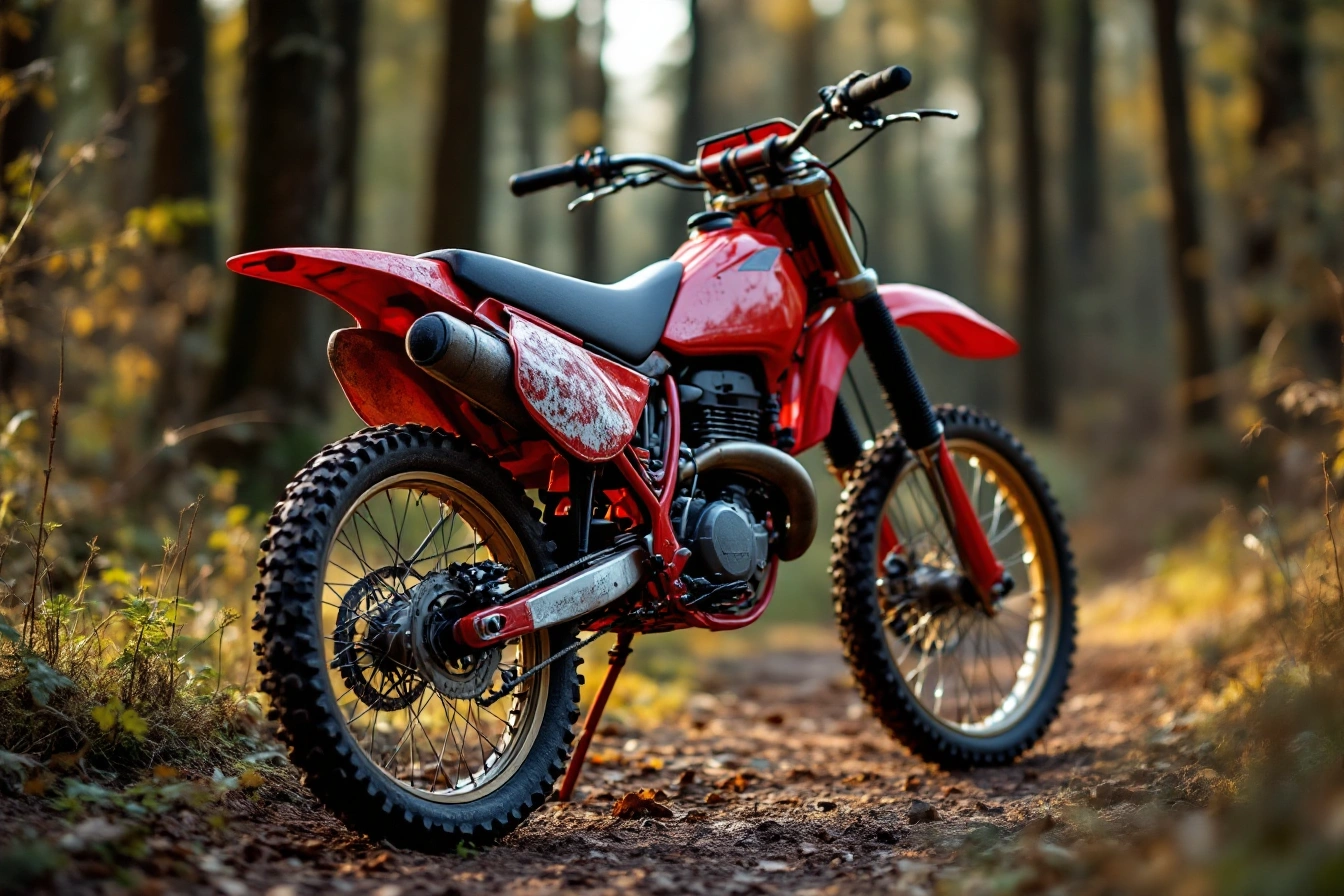
Honda has been in the dirt bike business longer than most of its rivals and has changed direction more than once. It built the first Japanese production motocross bike that mattered, then led the move to four-strokes, then built a trail bike range that became the default first bike for a generation. This guide covers the families, the history that explains them and what to check on a used example.
Early Honda dirt bikes
Honda started with small engines for bicycles and grew into a motorcycle maker. Its first off-road models were scramblers rather than motocross bikes, and the CL series of the 1960s was built for riders who wanted to leave the road.
The company's racing program pushed the dirt side forward. Long-distance off-road racing gained popularity in the United States, and the XR family grew out of that desert and trail work.
The bike that changed the market was the CR250M Elsinore. Honda's own history calls it the company's first production motocross machine, and it arrived in 1973. Gary Jones rode it to Honda's first AMA Motocross Championship that year. A CR125M followed in 1974.
CR and CRF
The CR was Honda's two-stroke motocross line. It evolved through the 1970s and 1980s with liquid cooling, Pro-Link rear suspension and, in 1997, an aluminum frame on the CR250R. The CR was a serious race bike and remains a collector model.
Honda announced a move to four-stroke technology in 1997 and introduced the CRF name: CR for the motocross line, F for four-stroke. The CRF450R arrived in late 2001 as a 2002 model, with a four-valve engine and a chassis derived from the CR250R. It set the pattern for the modern motocross four-stroke.
The current CRF motocross range includes the CRF450R and CRF250R, plus the Works Edition versions. Honda's own racing material describes the CRF450R as the successor to the CR250R and credits the Unicam valve design for its compact head. That design is still used across the range.
The CRF name is also used for trail and dual-sport bikes. A CRF-F model is a trail bike; a CRF-R is a motocross bike. The letter after the number matters when you are shopping, because the two are built for different jobs.
The suffix tells you the job
Honda uses the letters after the model number to mark the bike's purpose. An R is a motocross bike with close ratios, stiff suspension and no lights. An X is an off-road or cross-country bike with a wider gearbox and softer suspension. An F is an air-cooled trail bike built for easy starting. An L or RL is a dual-sport bike with lights and road equipment.
The engine size and the suffix together identify the bike. A CRF250R and a CRF250F share a displacement number but almost nothing else. Check the model code on the frame or the paperwork before you compare prices.
This naming is useful on the used market because sellers often leave out the suffix. A listing that says "CRF250" could be a motocross bike, a trail bike or a dual-sport. Ask for the full model code and the VIN.
XR trail bikes
The XR was Honda's four-stroke trail and desert family. It earned a reputation for reliability and simple maintenance, and used XRs are still common on trail rides. Models such as the XR200 and XR250 became first bikes for riders who wanted a low-stress machine.
The XR is no longer the main trail lineup. Honda's current trail bikes use the CRF name and are aimed at the same buyer: easy starting, soft power and low maintenance. A used XR is still a sensible choice if the bike has been looked after, but parts availability and condition matter more than the badge.
Model years and specs
Honda's model names carry a year, but the VIN is the reliable record. Under 49 CFR 565, position 10 of a 17-character VIN is the model-year code, and the code repeats across decades. A used bike may be titled as a different year from the one the seller believes.
The frame number and the engine number are stamped in different places, and they do not match on most bikes. That is normal. The frame VIN is the one that matters for the title and the history report. Our Honda VIN page explains where to find both and how to read the characters.
Specifications change by model year and market. Use Honda's own model pages or the owner's manual for the bike in front of you rather than a spec sheet from a forum. A specs table copied from a different market can be wrong on lighting and emissions, plus suspension.
What changed by decade
The 1970s were the two-stroke years. The Elsinore arrived, the CR line grew and the XR trail bikes followed. The bikes were simple and light, and easy to work on.
The 1980s brought liquid cooling, single-shock rear suspension and longer travel. The CR became a more specialized race bike, and the XR became the default trail bike for riders who wanted reliability.
The 1990s were the transition. The aluminum frame arrived on the CR250R in 1997, and Honda announced its move to four-strokes. The two-stroke was still winning, but the engineering money was shifting.
The 2000s belonged to the CRF. The CRF450R arrived as a 2002 model and the motocross market moved to four-strokes. The XR faded from the lineup and the CRF-F trail bikes took its place.
The 2010s and 2020s brought fuel injection, electronics and a wider spread of models. A modern CRF is easier to start and more complex to diagnose than the bikes of the 1990s. That is the trade a used buyer has to weigh.
Checking a used Honda
Start with the VIN on the steering head and compare it with the title. Look for a restamped or welded steering head, which is a sign of a repaired or stolen frame. Check the engine number against the paperwork if the state records it.
On the bike, look for oil leaks at the valve cover and the cases, play in the linkage and wheel bearings, and a noisy cam chain on a four-stroke. A cold start tells you more than a warm one. Ask when the valve clearance was last checked and whether the seller has receipts.
Run a VIN check before you pay, and use the used motorcycle checklist at the viewing. A clean Honda with a known history is one of the safer used buys in the sport. A cheap one with a missing title is not.
Which Honda for which rider
A motocross rider should look at the CRF-R models. They are built for the track, with stiff suspension and a close-ratio gearbox. They are a poor choice for a beginner on trails.
A trail rider should look at the CRF-F models or a clean XR. They start easily, run cool and tolerate low-speed work. A dual-sport rider needs an L or RL model with lights and road registration.
A parent buying for a child should start with the size chart, not the model name. A CRF110F and a CRF125F are different sizes, and the right one depends on the rider.
Parts and support
Honda has a large dealer network and strong aftermarket support. That makes parts easy to find for most models, including older XRs and CRs. It also means there is no reason to accept a bike with a missing part that is still available new.
Check the price and availability of the parts a used bike is likely to need. A rare model with expensive plastics can cost more to own than a popular one with cheap parts.
Common used-bike problems
Older XRs are simple but not indestructible. Check the frame near the swingarm pivot for cracks, and the rear shock for a seized linkage. A bike that has been used for farm work may have a welded frame or a non-standard exhaust.
Early CRFs can suffer from valve seat wear, especially if the air filter was neglected. A valve check with a leak-down test is worth the money before you buy a high-hour motocross bike. A bike that is hard to start cold is a warning.
The CR two-strokes are robust, but parts for older models can be scarce. Check the availability of pistons, gaskets and plastics before you take on a restoration. A complete bike is usually cheaper than building one from parts.
A Honda with a genuine service history is the safest used buy in this guide. The brand's dealer network and parts support make repairs easier, and the popular models hold value. That is worth a premium over a cheaper bike with no history.
If you are buying a first bike for a child, the CRF-F trail range and the size chart are the place to start. A motocross bike is the wrong first bike for most young riders, and a used trail bike holds its value while they learn.
The short version: match the suffix to the job, check the VIN, and price the service the model needs. Honda's range is broad enough that the right bike probably exists. The hard part is choosing it honestly.
Sources: Honda CRF history timeline, Honda motocross history, Honda racing newsroom and 49 CFR Part 565, checked November 2026.