
Dirt Bike Tires
How to choose dirt bike tires: tread patterns for hard, soft and sand, when to replace them and how to read the DOT date code before you buy.
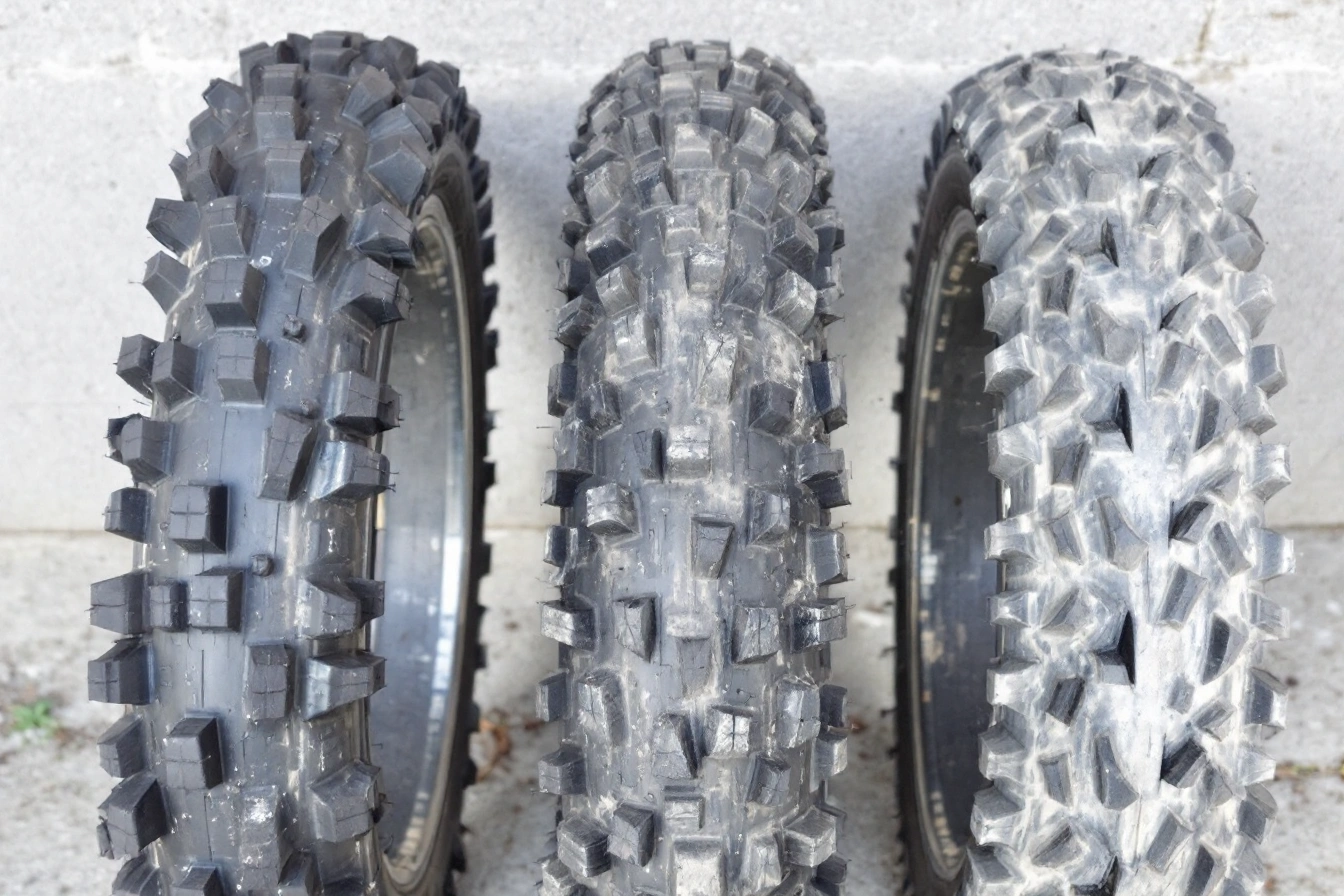
Tires are the cheapest handling upgrade on a dirt bike and the easiest thing to get wrong. A worn rear tire costs traction everywhere, and the wrong tread pattern makes a good bike feel vague in the conditions you actually ride. This guide covers the patterns, the wear signs and the date code on the sidewall.
Tread patterns
Dirt bike tires are built around the ground they meet. A motocross tire has tall, widely spaced knobs that dig into loose dirt and clear mud. An enduro or trail tire usually has a tighter, shorter block pattern that lasts longer and slides more predictably on rock and hardpack. Trials tires are a different animal again, with soft blocks and very low pressures.
The sidewall or the maker's catalog will usually name the intended terrain. That label matters more than the brand on the sidewall. Two tires from the same maker can be built for opposite conditions.
Hard, soft and sand
| Terrain | Tread and compound | What it does |
|---|---|---|
| Hardpack and rock | Short, closely spaced knobs, softer compound | Puts more rubber on a hard surface and resists tearing |
| Soft loam and mud | Tall knobs with wide gaps, harder compound | Bites into loose ground and throws mud clear |
| Sand | Paddle-style rear, ribbed front | Scoops sand instead of floating on it |
| Mixed trail | Intermediate block pattern | A compromise that works when conditions change |
Scroll for more →
Hard-terrain tires are not just a racing choice. On rocky trails and dry fire roads they last longer and grip better than a soft-terrain knob that folds over. Soft-terrain tires clear mud better but wear fast on gravel.
Sand rewards a paddle rear and a front with a strong center rib. A motocross tire can work in sand, but it will not hook up like a paddle and the front will push in turns.
When to replace
Replace a rear when the knobs lose their square edge or start tearing at the base. A front is finished when the side knobs undercut or the center blocks cup. Racing tires may be done in a day, while a trail set can last a season or more.
Check the sidewall for cracks and bulges, plus exposed cords. A tire that holds air can still be unsafe. Replace the tube with the tire if it has been pinched or patched more than once.
Look at the rim as well. A dented or cracked rim will not hold a bead evenly, and a rim strip that has moved exposes the tube to the spoke ends. A new tire on a damaged rim is a puncture waiting to happen. Spin the wheel and watch the tire seat as you inflate it. If the bead will not pop into place, then stop and fix it rather than riding on a partly seated tire.
Air pressure changes the feel as much as the tread. Low pressure in sand or mud increases the contact patch, but too low on rock risks a pinch flat and a dented rim. Use the pressure the maker and your manual recommend for the conditions, and check it cold.
DOT date code
Street-legal and many off-road tires carry a DOT code. Under 49 CFR 574.5 the final group of digits is the week and year of manufacture. A four-digit code is week and year, so 3219 means the 32nd week of 2019. The rule sets the four-digit code, but it does not set a replacement age.
A new-looking tire can still be old. Rubber hardens with age even when the tread is deep. Our tire date code reader explains where to find the code and how to read it. When inspecting a used bike, use a used dirt bike checklist to check the wheels as well as the tires.
Tubes and rim locks
A heavy-duty tube resists pinches better than a thin one, at the cost of a little weight. A rim lock stops the tire from spinning on the rim and tearing the valve stem when you run low pressure in sand or mud.
Check the rim lock and the valve nut when you fit a new tube. Tightening the valve nut hard against the rim is a common mistake. Leave it loose enough that the stem can move slightly, or fit the nut against the cap as the manual says.
Carry a spare tube and the tools to change it if you ride far from the truck. A flat in the middle of a trail is a long walk otherwise.
Mixing front and rear
Matching brands and models is the simple choice. A front and rear from the same family are designed to work together, and the pair wears at a similar rate. Mixing a soft front with a hard rear can work, but expect the rear to slide first and the front to bite in a different way.
Replace both tires at the same time when the budget allows. A fresh rear with a worn front pushes the front in corners, which is the opposite of what most riders want. If you must replace one, put the new tire on the front.
Keep a note of the size and the date code when you fit a set. That makes the next order simple and tells you how long the pair lasted. It also stops you buying the same old stock twice from a clearance bin.
Store spare tires out of sunlight and away from ozone sources such as electric motors. A tire that has been cooked in a shed will harden before it wears out.
Source: 49 CFR 574.5, checked November 2026.